
Since the publication of the interim report by Professor Becky Francis and the expert review panel, many organisations and individuals have come out with reaction to its’ publication. Some have made relatively positive sounds, others have voiced a feeling of deflation or lack of “tangible” actions. It is important to remember that this is an interim report, and the full report will follow towards the later stages of 2025. More importantly, the interim report provides insights, hints or fully fledged commitments to next steps. Here I set out what I personally feel can and might be inferred as insight into the future for Design and Technology based upon this report, though these are purely my personal reflections…
Design and Technology gets a mention!
The first thing to point out is that Design and Technology is explicitly mentioned in the interim report. Not only does it get a mention, it gets a number of mentions, unlike some subjects like Food and Nutrition which does not feature at all. Here are all the mentions of D&T:
Extract 1
Extract 2

Extract 3
Extract 4
What do these mentions tell us about how Design and Technology has been represented within the interim report?
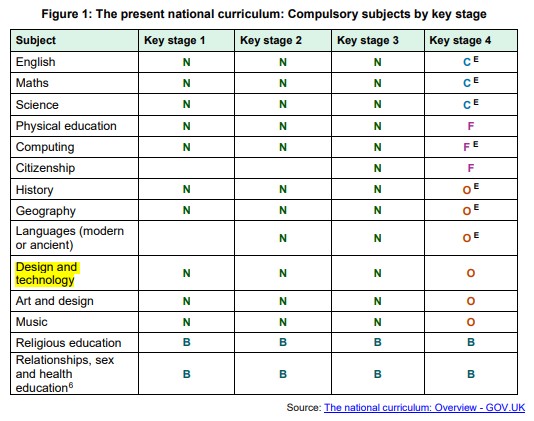
The first extract mentions the fact that D&T is a national curriculum subject that must be provided by schools at Key Stage 1, 2 and 3, but as an optional subject schools must offer (from a wider group of subjects including History, Geography, Languages, Art and Design, and Music).
Whilst this is purely factual information, for some secondary schools, knowing that they must provide D&T at KS3 is an important reminder, and not only D&T but within that Food and Nutrition, which forms part of the Programme of Study. Other secondary schools will likely benefit from knowing that D&T does not have to be offered at KS4 (as long as other optional subjects from the aforementioned pool, are offered). But fundamentally the key message missed here is that at KS1-3, D&T includes Food and Nutrition, and as such the subject will need to travel in the same direction as D&T.
The second extract is interesting. Whilst outlining the potential uptake of subjects at KS4 in the context of Ebacc, the extract states that D&T appears an outlier compared to other optional subjects, in relation to entries. How to interpret this is purely personal, but it could indicate that there is more than just “the Ebacc” at play with the decline of GCSE qualification entries. Many argue that the Ebacc is the blame, and I understand that position. However in contrast Art and Design is a subject that continues to, quote, “thrive” according to the report. Further to this extract, the report goes on to suggest that the take-up of technical equivalent courses, in this case one would assume to be referring to vocational Engineering, should be accounted for in the decline (of D&T?), and whilst Engineering is not named, the report groups “arts qualifications” together and infers that take-up of these qualifications at KS4, for which D&T is one, is potentially more stable. National entries might disagree with this position, but this could infer a position for this report that D&T is not in trouble when bundled up within a suite of technical subjects. But I digress…
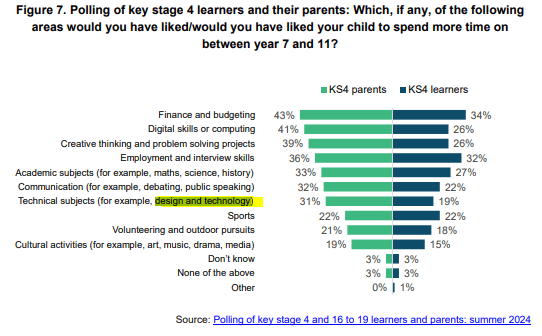
The third extract is equally interesting. When polling KS4 students and their parents, 31% of students and 19% of parents would have liked (their child) to have spent more time on technical subjects between years 7 and 11. Design and Technology is listed as a technical subject here (not arts as was previously referenced in the report). This would suggest that 1 in 5 parents would have liked more of subjects like D&T (assume other technical subjects like engineering are also part of this desire) between year 7 and 11, but not specifically/soley in GCSE D&T (which would have been a nice question to ask) and nearly 1 in 3 students would have liked to have more D&T (or engineering) between year 7 and 11, but again not presuming just GCSE D&T.
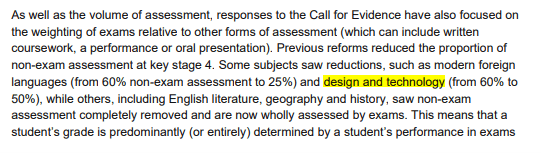
Our fourth and final extract is in the context of volume of assessment, where the report plays back an existing fact to us as the reader, which is that GCSE D&T previously had a different balance of assessment, which was 60% coursework and 40% written examination (or as I call it, the good old days). It further states that this previous balance would have seen less reliance on the terminal examination for a students final grade, with more assessment value attributed to a student’s performance at different points across the course. This is nothing insightful, purely factual. There is a little negative comment linked to this section also, which is that some responses to the interim report felt that terminal written examination “may not give students the opportunity to fully demonstrate their capabilities”. This infers that coursework might be a better assessment method to help students demonstrate their capabilities in D&T, though we do not have this comparison data to hand of course.
Though there are only 4 references to D&T, as one might expect for a none core subject, what we can now confirm (because it is in this report in black and white) is that responses to the CAR evidenced:
- Entry decline of GCSE D&T
- Students may be studying a BTEC or similar instead of D&T
- The assessment balance for D&T might not be quite right compared to a previous iteration of the GCSE
- There appears to be some sort of demand not being fulfilled for both parent and student in secondary schools (though not specifically about GCSE D&T)
- That D&T (and Food and Nutrition) is compulsory at KS1-3 and optional at KS4.
The one aspect of the report so far that concerned me was the lack of clarity around how D&T was defined. Is it a technical subject or is it defined under the arts? It is concerning that a report of this nature doesn’t clearly define what a subject is. Maybe this reflects one of D&Ts’ problems, is it an art, or is it a technical subject? The name would suggest both, but perhaps being clear on which it is might give the D&T community more or less hope for this report. As you can see, explicit reference to the subject is pretty thin, so the next task is to look more closely at the wider proposals, and try to identify if these will impact D&T or not. This is what the next part of my article aims to do.
What might we be able to infer from the wider paper where D&T is not explicitly mentioned?
For me, this is the part that very few have done so far, choosing to stick to the headlines rather than the detail of the paper. This is understandable, as this is the job that takes time to both read the full report, and for each action, infer what it means for D&T. Given that most teachers are currently on Easter break, or are far too busy doing their job (especially at this time of year with coursework deadlines looming), I am pleased to offer a dissection, from my personal position.
I have analysed the report in three sections. I start with the executive summary, then I look at what the report states are the next steps, and finally I look at the wider report. Here is what I feel you can extract from the interim report, which, “if” any of its statements apply to D&T, will set the subject on one of a number of pathways. Enjoy!
Section 1: The Executive summary
The national curriculum needs to be refreshed to remain cutting edge and fit for purpose, which requires us to address its problems.
– Fantastic, if the CAR response evidence identifies the current state of D&T as a problem (the entry decline, less specialist teachers, reduced curriculum time, etc) then we could see a refresh of the curriculum to make D&T fit for purpose. The ultimate question is… Is D&T fit for purpose? My view is no, as it was designed in an age of more traditional craft design and technology, for which the world has moved on and now requires different things, which should be reflected in the curriculum taught to students. I know some would argue that the current curriculum provides all of the necessary opportunities for a modern D&T curriculum and that we just need time and resource to improve the classroom practice. My personal view is that if we are going to have a chance to refresh, lets refresh things and cut back the craft, and dial up the essential knowledge that children will actually use in the future.
The curriculum needs to prepare young people to address civic and economic needs of the UK and world, through knowledge and skills for the workplace.
– Fantastic, if this applies to D&T, we might see new content relating to challenges faced by the UK and world, such as access to healthcare and education, immigration and population growth, safety and crime, or social equity and inclusion, all of which design has a part to play. Does D&T offer this currently? Again you might argue the GCSE contextual challenges do. But for me, the opportunity we could have here is to give the subject an epistemological boost, which place people, places and the planet at the heart of everything we do through the process of design.
Education needs high standards for all, not just for some, by removing barriers to student progress, not changing what is working well in the current system.
– Hard to predict what this might mean for D&T, but if there are barriers to students accessing good quality D&T education, this would need addressing. This could mean better access to specialist teachers which is a known area of concern for the subject. Whilst the national demographic data of D&T teachers is estimated at 6,000, this is based on the number of hours taught of the subject across schools. This does not therefore account for none D&T teachers teaching the subject. If I had to guess, I would put national numbers at around 4,000 at a push, with retirement and recruitment shortfall set to only reduce that figure further.
The curriculum to 16 is reasonably broad and balanced, with positive impact on attainment from taking a knowledge-rich approach through the key stages in relation to the qualification choices.
– Fantastic, it sounds like we will keep GCSE and A Level qualifications, and related T-Levels, but perhaps not so positive for other vocational course options. It also does not bode well for anyone who feels D&T should not be taught as a knowledge rich curriculum, but more a skill or capability course. Knowledge rich is here to stay, whether we like this or not. So perhaps we just need better knowledge…?
The system for SEND is not working
– Agree, but perhaps this isn’t for D&T specifically to concern itself with, more for the whole sector to respond to. It is important to not exclude access to D&T for SEND students, and perhaps this is something that could be addressed (if it is happening of course).
Strong evidence suggests securing mastery of a subject raises’ standards, but content needs to be appropriately defined in doing this.
– Something for D&T to be thinking about. There is a lot of noise from the D&T community around the breadth and depth of content, rightly or wrongly. Many have recently articulated that the content volume is substantial. My view of this is “prove it then”. I hear lots of science teachers stating how tightly packed their curriculum is (miss one lesson and that lesson is gone…), whilst I have seen plenty of D&T teachers spend 12 weeks making wooden joints. D&T doesn’t feel under the same pressure that science does, but perhaps I am wrong? But… mastery of D&T does require the right content and opportunity for students to not only acquire it, but also adapt and extend beyond it, and for me we (the community) cannot say we know what D&T mastery is (I would liken this to previous writings by Barlex and Steeg on the challenge of defining what D&T knowledge actually is).
Given that this point is earmarked in the report for further review, we could see D&T as a subject going under deeper focused scrutiny, which I feel could be a good thing (if the right people are at the table of course).
The performance measure, Ebacc, has had an impact on student choice (as it was designed to do of course), which needs further analysis relating to the choices of young people.
– This is interesting. It is worth pointing out that stating the Ebacc has had an impact on student choice is obvious. That is what it was designed to do. And it is fair to surmise that this is exactly what it did. Is this a signal to the end of the Ebacc? Perhaps. Is this beneficial for D&T? Personally I think getting rid of the Ebacc could have a marginal impact on GCSE entries, but teachers working in certain schools might feel much more positive about the potential for this, especially where students have limited choices for GCSE options because of a system put in place by the school to raise the number of students that qualify for the Ebacc (for which D&T has a marginal role as we all know). One thing to think about is that, in the years of Ebacc, the subject has seen the greatest decline of any qualification for GCSE entries, and with that we have also seen a reduction in specialist teachers, the closure of workshops, the selling of equipment, and the reduction of teaching time in the timetable. Removing the Ebacc does not do anything about any of those things, but perhaps creates an environment for these to begin to be solved.
Given that this unpicking the impact of Ebacc is identified as an action point, we should expect to hear more about this in 2025.
The curriculum needs to respond to social and technological changes (since the last reform)
– Fantastic, this surely loops D&T into the picture given the technological change that has occurred in the past 12 years, and the shifting priorities for society such as responsibility for the climate. AI may or may not be a positive challenge for the subject. It remains largely at odds with assessment of coursework currently, but in the creative industries it has an increasing role, so one could predict that future D&T qualifications would see the integration of AI as part of the creative process in the future. One could also see a future in which AI is blocked from assessment, and any assessment that leaves the door open to malpractice using AI could be at greater risk. Perhaps we need to start thinking about observational assessment of D&T?
16-19 qualifications and the clarity of pathways appears less solid and potentially a problem that needs further research and consultation
– For GCSE and A level D&T, this doesn’t seem to be an issue, but for the other Level 2 and 3 qualification routes, there are perhaps questions to be asked of the value and clarify of these pathways compared to the GCSE and A Level qualifications. Perhaps this one is worth keeping an eye on if D&T is unintentionally (or intentionally) defined as a technical subject (as it was in the report extracts) which would place it at risk of more significant review in the near future. For me, the perfect world was having a GCSE in D&T, and a BTEC in Engineering alongside it. We didn’t need anything else, but those qualifications needed to be different to cater for differing student needs.
Section 2: Next steps
I am now going to look at the list of next steps in the interim report, and tackle these one at a time.
The relevance, volume and diversity of content
– Fantastic… if D&T is in this camp.! The current content for D&T does not feel reflective of what the world needs to prepare students for, particularly in reference to changes in society and technology. Again I don’t mind people arguing that the current curriculum is sufficient enough and that we just need to do better with it. I feel personally this is a chance to make the British education system stand out when it comes to the thing we are historically good at… Design! Lets lead the world for responsible design and make sure we train OUR students to care for the planet as much as they care for meeting the needs of the people in it.
There will be deeper analysis of each subject to test a range of solutions
– This should impact D&T given the reference to its decline in entries (though we must remember that it was stated in the report that on balance D&T has not declined if accounting for technical qualifications). One would hope that this testing considers all opportunities for the subject, and addresses the root causes of the issues it currently has, not just those experienced on the surface.
The impact of Ebacc on young peoples choices and how schools behave in relation to this.
– This will directly impact D&T, but it will be down to how the research goes as to whether it will have a positive or negative impact. Though it was stated that Ebacc has had a negative impact, vocational entries could potentially indicate less of/no problem to be fixed, especially given the lack of clarity from the parent and student survey data that the report included.
Equip children for a technological and changing world.
– I really do hope that D&T is included in this, but I fear that if there is any objection to the adoption of climate responsibility as “tokenistic” as we saw in 2023, or AI is seen as “inappropriate” for coursework, then D&T could miss the boat. Its nice to see many organisations adopting the position that D&T could be dialled up on the sustainability and climate front. It makes me a little proud to have been the first person to actually shout that out through my day job, but all the same, we need to keep the D&T community moving towards this.
Pathways to level 3…
– Potentially something for GCSE D&T to reflect upon here, and potentially something that could trigger change to the GCSE Specifications? Does the GCSE course prepare learners to make the choice to move to a T-Level in a relatable field of study to D&T? If not, does this suggest that (given T-Levels appear to be going nowhere) we could see D&T GCSE requiring a change to facilitate progression and suitable sequencing? If you imagine GCSE D&T being what it is supposed to be, a GENERAL qualification (that’s what the G stands for), then the qualification cannot be overly prescribed with content that prepares students for A Level D&T only, given that this is not the only level 3 pathway to exist. The GCSE needs to be general, not specialist, and support the progression of all learners to level 3 qualifications (A Level, T-Level, BTEC, and also subjects that are not D&T).
Strong occupational pathways at Level 2 and 3
– What does this suggest for D&T? Is D&T actually now a technical subject, not an academic course? Does it need to only be in the vocational space, or will it retain its academic (GCSE) status? My view is that if key stakeholders push really hard on the practical and hands on learning message that they have done in the past, it waters down the argument that D&T is academic, and potentially risks the subject going all together. For me, D&T can be academic, but it needs academic knowledge and content, and anything heavily practical is perhaps more for the vocational qualifications (given that vocational courses are designed to lead to employment).
Changes proposed will not destabilise the system
– This should give all (D&T) teachers the confidence to know that their jobs and the subject are not at risk, and that changes are ultimately in the best interests of the findings of the review. To not destabilise the system, one would assume that any changes ultimately made will feel small, but changes will open up opportunities where they were previously closed, and remove barriers that have been artificially in place for the past 12 years.
Section 3: The wider report
Beyond the executive summary, here are some bodies of information that feel relevant to consider for D&T, presented as a table with extract on the left, and how I see this might correlate to D&T on the right.
| Statements in the interim report | The potential impact for D&T |
| At KS4 students typically take 8 GCSE qualifications and 1 vocational award, and the choices are influenced by the Ebacc, Progress 8, and Attainment 8. | Unless significant change is made beyond removing the Ebacc (if this actually happens), it is unlikely that more qualifications will be taken by students. The choice of those 8-9 qualifications could be influenced less by performance measures for schools (like the Ebacc), and perhaps this might make subjects like History, Geography, Languages and Computer Science more nervous, than D&T. |
| A refreshed national curriculum should; provide rigorous and knowledge rich education, remain relevant and up to date linked to our cultural past, should empower a love of learning a subject in a local, national and global context, develop students for future life and work, be coherent and sequenced with space for mastery, retain aspirations for high quality and aspirational learning. | The D&T curriculum, if reviewed and refreshed, would need to remain knowledge rich in focus, include past design and engineering achievements, continue to provide study and exposure to design from local to global contexts, relate to the world of work (which is where it likely struggles given the decline of making with the hands). Ensuring mastery and progression through the Key stages, which is an issue for D&T (where the curriculum simply does not sequence purposefully between and through Key stages) might mean we need to see adaptations to the curriculum and more explicit content to sequence the stages together. |
| Some subjects in the arts have been squeezed, related to a challenge of breadth or depth in the study of subjects, and how to balance this. | If D&T provides depth currently, it may need to address this through a reduction to this. However, if D&T provides breadth currently, it may need to address this instead. Some D&T folk feel that the current GCSE in D&T requires both breadth and depth because of the material areas, for which the solution is to either reduce the breadth and depth, or advocate for more radical solutions such as a return to material specific qualifications (e.g. GCSE Resistant Materials or GCSE Textiles). |
| Improvements in equipment and more specialist teachers are issues passed back to the DfE. | Whilst ensuring all students have access to the same equipment is impossible in our education system, equitable access D&T as part of the curriculum should be equitable in relation to anything that impacts a students qualification grade. This might mean more equitable assessment which negates the benefit of having access to specialist tools, equipment and resources. Likewise, access to specialist teachers is part of this discussion. This issue is also one for the workforce team in the DfE to address, which could see more action taken to encourage teachers to join the workforce or stay longer in the workforce. |
| KS3 is preparing students for GCSE during Year 9, narrowing the curriculum for students. There is also evidence of repetition of curriculum between KS2 and 3. | The national curriculum is designed to sequence between key stages, but perhaps for D&T this is not happening as well as other subjects like Mathematics and English, where the curriculum sequencing is much more accurately developed. I have always questioned the role of carousels between material areas, where the same learning is taking place and the only variation is the material you give to students, so perhaps this might be something to address by advocating to remove carousels in schools? |
| The Ebacc pre-selects 7 or 8 subject choices for students, limiting the choice of arts and other non-Ebacc qualifications. | D&T may become a more available GCSE option to students who previously were steered towards selecting subjects like History, Geography, a language or Computer Science in relation to the Ebacc measure, which could see future entries for D&T improve if the Ebacc is discontinued. This might not be a likely outcome given the historical data that shows that increases in the total pool of students at GCSE age does not equate to more students doing D&T for GCSE, and often any uptick in entries that sometimes is celebrated is actually a real terms decline in the percentage that take the qualification. Just because more can do GCSE D&T does not mean more will want to. |
| Parental and student survey outcomes indicated a desire for more opportunities to learn about digital skills; creative thinking and problem solving projects; employment; technical subjects (like D&T) | Though many D&T teachers might argue that D&T is able to provide digital skills, creative thinking, problem solving projects, employment information and technical study, it could be an opportunity for the subject to leverage this shortfall by “dialling up” these aspects, particularly the use of digital skills in design and make projects, and equally around how the subject approaches creative thinking and problem solving. I’d love to see more CAD, more recognition for digital approaches, and more reward for creativity within the assessment of students. |
| The balance of breadth and depth, particularly in instances where a lack of specificity is counter intuitive for teachers results in a lack of clarity and can lead to greater volumes of content. | For D&T this could be an area that impacts the current programmes of study. Where these lack specific content to be taught, teachers will interpret them for themselves, creating potentially more content burden. With more specificity, the volume of content can be more “controlled” and as such reduced for some teachers. |
| A need for the curriculum to do more to help students feel represented. | D&T has a wonderful opportunity here, and perhaps should start to address the challenges it has around the diversity of its entries. I have been shouting for a while about the declining numbers of girls taking the subject (their entries are declining faster than the decline of boys), and much of my work has been looking at how girls see the subject. A lack of diverse students progressing onto A Level and further or higher design related education is a big issue for me. Currently D&T remains in many spaces dominated by privileged white males. |
| In the next phase of review there will be a look at opportunities to reduce overall volume of assessment at KS4, without compromising the reliability of results and trust of stakeholders, conducted subject by subject to consider fitness for purpose and impact of different assessment methods (risks and trade-offs of NEA, deliverability, malpractice and equity). Exam assessment should remain the primary means of assessment across GCSEs. | This could potentially be where D&T has a chance for change, but where it is also at risk of an enforced change. Whilst the volume of content challenge is linked to breadth and depth perceptions and a lack of specificity in places, there are further factors that do impact this (for example whether the teacher is specialist, lesson time, etc) that are beyond the scope of this review to some extent D&T will need to be able to articulate what methods of assessment are suitable for the subject at GCSE, knowing that written examination will be the primary means of assessment. The advent of AI and existing equity challenges in the system (access to workshops, equipment, tools, materials, software, hardware, etc) are also not going to aid D&T in building a undisputable evidence base for changes to assessment, but given the subject by subject approach this review will take next, there is scope to propose (within reason) changes to the assessment of GCSE D&T, which I see as positive! |
Conclusions
The interim report is now a published document in the education space, so we cannot ignore the messages it conveys about D&T. Many have tried to point to other evidence but reports like this are a marker in the ground, from which we move forward. Whilst the report fails to draw on data that would show an even greater decline in GCSE entries (when the subject was compulsory at KS4), and what data it does present appears to lack the specificity needed to know what the true extent of the problems are for the subject, we now as a community need to work from this report. Arguing against it is pointless, and ignoring it would be foolish. If you feel D&T should have been represented differently in the report, it would have come from the 7,000 submissions that were made to it. Those submissions gave us this, and it is now time to work from this position.
It feels safe to expect to see the Ebacc either downgraded or discontinued, that would be my strongest guess. Ebacc had a job, it did that job, it impacted the students in a range of ways, and the system responded to the measure at the expense of free choice. Whether removing the Ebacc is a step towards addressing the decline in GCSE D&T remains up for debate, as there is certainly more to the decline of D&T than just its position within one schools performance measure. But with the demise of the Ebacc there will be hope, and rebellions are built on hope.
The next phase of the review, which will see D&T involved to some extent in a more detailed “deep dive”, provides an opportunity for the D&T community to evidence what it wants and needs for its future. For me personally, this is the time to be active as a D&T teacher. Rather than feeding your views into an organisation which offers to put them forward for you, do it yourself. This is the only true way to get your voice heard.
Whilst the future of D&T may have previously felt out of our control at times, it might now be entirely within our scope to impact and improve, and I for one will personally respond to any call for evidence, alongside doing so through my employer. If we can collectively create a convincing evidence base for what we believe are the root causes of the subjects content and assessment issues, and provide suitable and appropriate solutions, we will be in a better position. Historically (in my view) the wrong people have been empowered to define our content and assessment. Now is the time for the D&T community to steer this ship.
There is of course a risk of inaction, for which I hope to have conveyed to anyone still reading this. Without genuine focus, or with multiple different directions articulated as part of any deep dive, the risk is that no single conclusive outcome is achievable. Debate is good, different opinions are also good. But when a challenge is aimed at the value of D&T, it is hard to form a rebuttal without a cohesive voice.
I personally feel the future of the subject is in the value it provides toward transferable and none practical design skills, which are utilised in a breadth of ways to design solutions, which include the creation of the physical and digital, realised as products or services, making new things or designing them out of systems, or even using design as a power for communication and changing the behaviours of people. I also feel strongly that vocational and practical hands on designing and making should be part of the curriculum, but that this experience take a secondary place to the academic knowledge and transferable skills that will serve young people entering the world of work. This is after all what the report articulates as the purpose of our curriculum, aiming to improve our civic and economic future through an impactful and aspirational education.
Thank you for reading my deep dive into the interim report, and see you again for what follows for D&T in 2025!
 Phil Holton