
Context
In November 2025, the UK Government released the full report of findings and next step recommendations following the completion of its Curriculum and Assessment review. The review itself received over 7,000 contributions, with stakeholder submissions ranging from parents to professional organisations. This analysis of the submissions is a supporting document to the report which helps to understand which trends were identified by subject, whilst this response report states what we should expect the immediate next steps to be.
Summary of any documentation which specifically reference to D&T
Whilst many will engage with the final review document and jump directly to page 66 to read about the findings for D&T, for the purpose of creating a full story of the CAR findings, I am going to outline below, in order, what each of the three documents cited for D&T.
Findings for D&T (in the order they appear in the document)
- D&T has a role to play in enriching thoughtful use of digital technologies, e.g. 3-D Modelling. (page 38)
- “D&T has no focus on sustainability, despite the importance of material choice and renewable supply chains in this subject.” (page 40)
- The recommendation is to bolster climate education and sustainability in D&T, including consideration of sequencing through the key stages. (page 41)
- 57% of state funded schools entered for GCSE D&T in 2025, whilst A level entries made up 1% of entries in 2024 vs 2% in 2010. (page 66).
- The subject is in poor health and decline since 2005, with the Ebacc measure seen as a contributor to this. However uptake had been in decline since 2000, prior to the Ebacc, when the GCSE was made non-compulsory. (page 67)
- D&T is not offered consistently across schools, despite Ofsted expectations for “breadth and ambition” for the National Curriculum. (page 67)
- Free schools (57%) and sponsor-led academies (52%) make up a greater percentage who do not make GCSE entries into D&T. (page 67).
- 17% of KS3 students wanted to study D&T where they were unable to. (page 67)
- Disadvantaged students make up the highest proportion of students not making entries to GCSE D&T.
- Issues that sit beyond the scope of the review include; lack of specialist D&T staff, linked to the poor performance of providers to meet Initial Teacher Training targets for a number of years. The DfE is committed to tackling this issue after the conclusion of the review. (page 68).
- Despite wider barriers, the curriculum content can be refreshed to make the subject more relevant and easier for schools to deliver. (page 68)
- Primary D&T is broadly working well, but transition to KS3 is problematic. (page 69)
- The purpose of study and aims of the curriculum are outdated. It requires a clearer distinction of its practical nature, that builds D&T capability to support students to become both designers and engineers. This is associated with updates to KS3 to support progression to GCSE, including more embedded problem solving, iteration and testing. (page 69)
- On the topic of materials, stakeholders raised the importance of decision-making, working with a range of materials, linking this to contextual understanding of material choice, and moving away from memorising materials and properties in isolation. (page 69)
- Social responsibility and inclusive design should be explicitly embedded, including learning green knowledge and skills, related to how students solve problems related to societal and environmental issues. The current programme of study does not mention sustainability and circular economy. (page 69)
- The “final product”, particularly at KS3, required greater definition, to consider iterative design and prototyping, whilst retaining high quality making. (page 69-70)
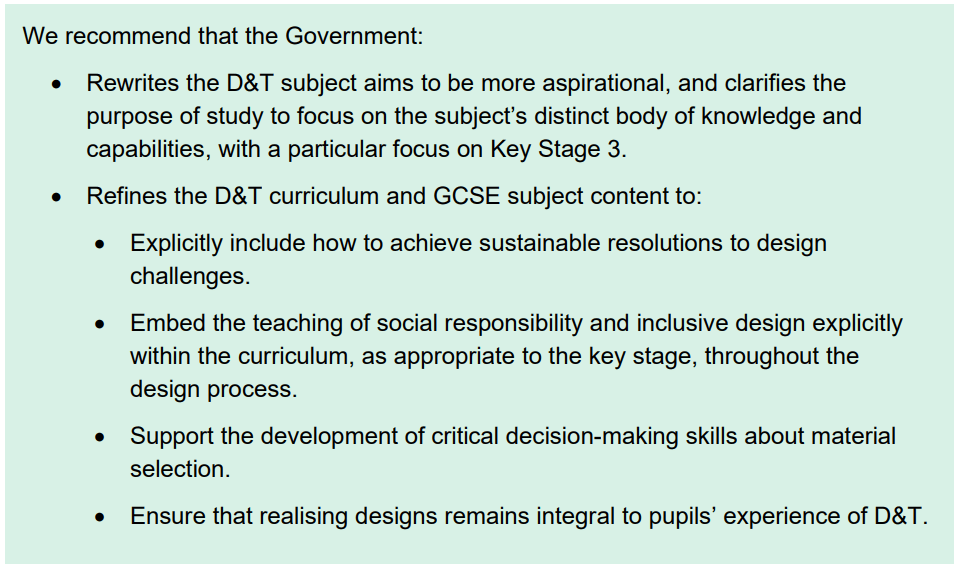
On page 70, the review sets out its recommendations:
The analysis of submissions report states the following about D&T
- A small number of respondents mentioned D&T as working well. (page 7)
- D&T is recommended as a priority subject when proposing content reduction. (page 27)
- There were thematic patterns from submissions pointing to D&T having outdated content, and therefore is unfit for purpose due to the changing nature of technology. (page 28)
- Thematic patterns of submissions recommended greater focus on sustainability, artificial intelligence and digital design. (page 28)
- D&T is a subject identified with concerns relating to the sequencing of the curriculum, i.e. chronological study of the subject and progression between Key stages. (page 29)
- Respondents recommended that D&T should be made more inclusive by introducing stories of engineers and innovators from backgrounds that are under-represented. It suggests that this would support more diverse uptake of the subject. (page 30)
- D&T decline is potentially linked to insufficient funding/resources and shortage of specialist teachers, along with a lack of inclusion of the subject in government accountability measures. (page 41)
- Solutions recommended through the submissions to the review included; investing in resources; increasing teacher training; integration of the subject with others; adding subjects to the Ebacc; and external sectors inspiring and training teachers. (page 41)
Lastly, the government response report states the following for D&T
- The government will “take the opportunity to enhance the climate education content which is already present in the national curriculum… (to include) sustainability within design and technology programme of study”. (page 25)
- “We will revise the design and technology curriculum and GCSE subject content to focus on developing pupils’ design capability and introduce the concept of sustainability within the programme of study” (page 29)
- This will help the country to tackle challenges around building a sustainable economy through more discerning use of materials and processes. (page 29)
How do we summarise this into a concise story about what stakeholders said, and what the government recommends?
In the following statement, I have attempted to summarise all of the above:
“Stakeholder feedback highlights that Design & Technology (D&T) is in long-term decline, with outdated curriculum content failing to reflect the changing nature of technology. Respondents emphasised the need for greater integration of digital technologies, artificial intelligence, and sustainability, alongside clearer progression from Key Stage 3 to GCSE. Concerns were raised about inconsistent provision, barriers for disadvantaged students, and systemic issues such as insufficient specialist teachers and lack of inclusion in accountability measures. Stakeholders also called for embedding social responsibility, inclusive design, and contextual understanding of material choices, moving away from rote learning.
The government recognises these themes and acknowledges the subject’s poor health and structural challenges. It intends to refresh the curriculum to make D&T more relevant and practical, focusing on design capability and iterative problem-solving. Sustainability will be explicitly embedded within the programme of study and GCSE content, supporting national goals for a sustainable economy. While teacher recruitment and training remain critical, these will be addressed after the review concludes. The overarching aim is to modernise D&T, improve progression, and ensure equitable access, making the subject easier for schools to deliver and more attractive to students.”
Some immediate thoughts on the government’s key recommendations (green box)
We should expect to see an early update to the following subject aims
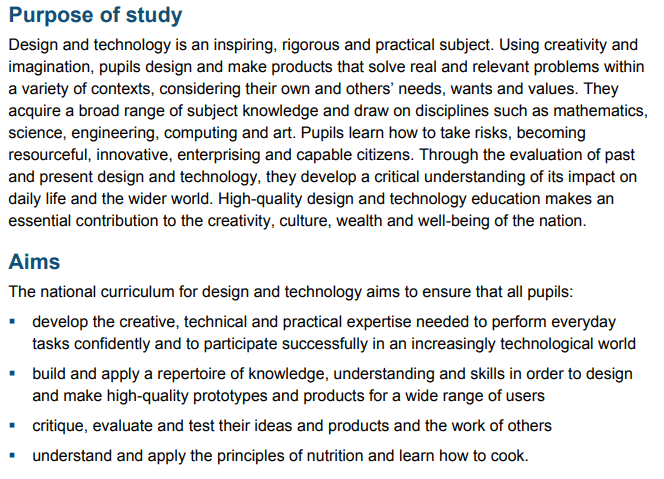
Currently KS3 programme of study purpose and aims read a follows:
Currently KS4 aims and objectives reads as follows:
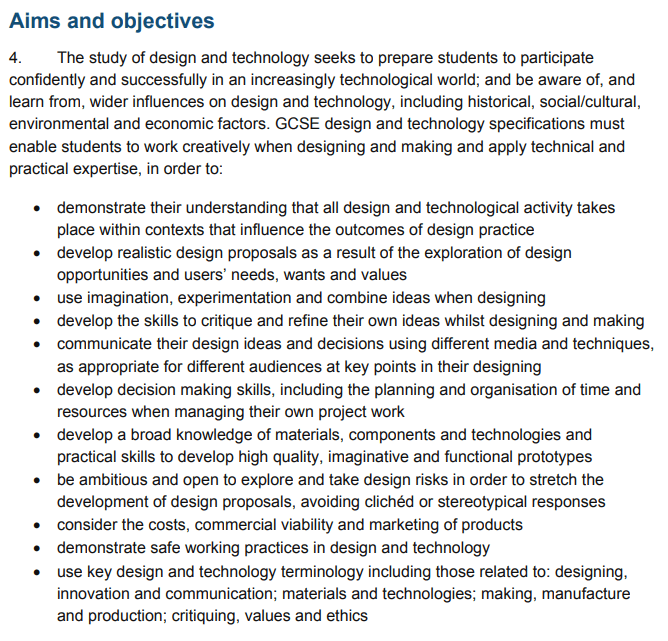
For these two documents, it would be fair to assume we will not see a complete re-write of these, but more of an evolution of language and certain statements to account for explicit inclusion of sustainable solutions to design problems, social responsibility and inclusive design into the design process.
Developing the critical decision making skills about materials selection will be interesting. I love this definition that popped up when I Googled the term “Material Science”
“Materials science is the study of the structure and properties of materials, and how they can be used to create things that improve our society.”
Material science holds great relevance to the study and application of materials at degree level, and therefore feels like a term D&T teachers could become more accustomed to, in order to realign the subject to a purposeful progression pathway through and beyond our secondary school education system.
The ambition for material selection could likely be a reference to KS3 and often sadly KS4 study of D&T, in which materials are pre-chosen by the teacher for a “project” or activity. Whilst there are a number of reasons why this happens in schools (not least the cost of providing students with access to those materials), we could see a broader ambition for materials translated into the aims of the subject which encourages teachers to provide more open ended problems to solve, with divergent opportunities for students to make their own choices about the application of materials.
“Realising designs” is an integral phrase that completes the list of refinements we should expect. It supports the retained ambition that D&T should allow students to create solutions to problems, and where appropriate, make these with their hands, tools, equipment and materials. It leaves the door open for making to remain central to subject interpretation, but also encourages (in my eyes) opportunity for digital solutions and solving problems by removing products from the world. Realising a design is for me, the opportunity to actually design things, something that should be essential to the subject and for all students to experience. Perhaps the challenge here is for departments to decide in which instances the activity of making has greatest value, and avoid trying to simply make everything.
What are my thoughts?
The CAR exposes a profile of D&T within UK state schools that is not good.
It is positive to acknowledge that it is now the minority that believe that there is nothing wrong with D&T, with the majority in favour of change. This was not the case in 2021 when I worked on the “Future of Design Education” project through my full time role.
The subject is not inclusive, it does not sequence through the key stages, it is guilty of teaching materials in disconnect to their use, representation of designers and engineers is often skewed to a handful of names (often white often male) and the GCSE qualification requires a content reduction. Despite managing to provide a broad range of designers and engineers to study through the awarding body I work for, a list that feels very inclusive, it has not been the case across all specifications and echoes a less inclusive study for the majority.
At the same time as reducing content, the GCSE and KS3 programmes of study currently include content that is no longer relevant to the present day design and engineering sectors. D&T’s purpose within the national curriculum is to prepare the UK economy to shift towards a circular economy, which in the light of advances in technology, it currently is not capable of doing.
The Ebacc has been debunked as the protagonist of the decline in GCSE D&T entries, given the decline that took place 5 years prior to its introduction. It is or was still a contributor, but decline was already happening far too long before it arrived in schools to be the sole reason. Proposal work by the government around progress and attainment 8 measures of schools models a couple of options (see page 4 and page 8) including the new categorisation of GCSE D&T, no longer placing it at odds with some optional subjects. This change might support schools to encourage greater uptake, and empower SLTs’ to open up qualification choices to achieve this greater uptake of GCSE D&T by their students. Funding, however, remains a separate and ever present issue. It might be that we see a natural decline in subjects like History or Modern Foreign Languages, that begins to encourage take up of GCSE D&T.
The lack of specialist teachers, without which it is impossible to offer effective D&T in schools, lies beneath what are surface level criticisms of the subject’s relevance to the needs of the modern world. The recommendations around sustainability, materials and acknowledging that the purpose of D&T needs to change to better serve students, are necessary and are made in spite of the root issues that the subject suffers from.
Those most affected by the decline of D&T availability within schools, are students from disadvantaged backgrounds, which is a tragedy in and of itself. This issue may well indicate that a certain profile of a school has been unable to maintain the provision of D&T to its students, due to a lack of funding and/or staffing. Free and sponsor-led academies are identified as the most common centres to not offer the subject, which perhaps reflects the freedoms afforded to schools to opt out of D&T. Clearly, Ofsted measures have not been sufficient to ensure schools maintain an offer of D&T.
Sufficient submissions to the review, across all stakeholders, strongly and repeatedly support the call to make sustainability, artificial intelligence and digital technology more prominent within D&T. This is welcome and reflects the work I led at Pearson which identified that these areas are what the design and engineering sector felt they needed from the subject of D&T, for it to regain greater purpose and value for student progression.
Primary education is not identified as an issue, which reflects great efforts made by the subject association. It is KS3 and upwards where the expectation of change resides. There is clear messaging within the various government documents that state that there exists a lack of progression and sequencing between key stages. This issue will likely result in more explicit and directed programmes of study for KS3 and KS4 being published in the new year. The D&T teacher community will need to adopt these more explicit curriculum programmes, which will be less open to interpretation.
Given that 83% of students who do not currently have access to D&T at KS3, are not asking to have access to D&T, a rebrand and refresh of the D&T curriculum could be a very necessary opportunity to change perceptions of the subject by both students and their parents. The lack of sequencing at KS3 may be a reflection of the commonly implemented carousel system in schools, where students rotate between material areas without planned progression of learning taking place. This is at odds with how subjects should be taught in schools, and points to a need to stop teaching isolated “projects” and move to the teaching of the subject as an effective all through curriculum.
The government has recognised that the D&T curriculum should be designed to serve the needs of the country, which includes upskilling students and curating pathways that lead to fruitful and valued careers. For this reason, social responsibility and sustainability are key to the subject’s future, due to the increased need for the workforce to have the necessary green skills across the creative and manufacturing industries, as they increasingly take responsibility for their impact on the environment.
Content reduction at GCSE alone will not create space for this new content, therefore there will need to be a greater reduction to existing content to create the space for social responsibility and sustainability, and achieve an overall net content reduction. Final content documents will need to be more explicit to ensure sequencing is clear and unequivocal. This will result in a major refresh of D&T as it is taught in the classroom today, with the likely end of carousel systems made up of material specific projects. This may require a review of D&T pedagogy and the need to look to other subjects to develop the right practices.
What are the misconceptions already circulating within the D&T community?
Often, the reaction to proposals of this nature are emotively driven, and less inline with fact. This is already the case with a number of D&T community members and retired members sharing their negative rhetoric which is a real shame. These are ones I have spotted so far.
This is the end of practical activities in D&T – Nope. In fact the contrary. The government states that the practical nature of the subject needs to be clearer, and that the concept of “final product” remains important to the subject, alongside a better understanding of iterative design and prototyping.
Social responsibility and sustainability are best placed at KS1 and KS2 – Nope. It is in fact at KS3 and KS4 where this content is more essential than ever, and sequenced from an appropriately linked primary curriculum.
We no longer need workshops – Nope. The government has set out the need to learn about materials in the context of their use, which includes a range of real world contexts and through practical work. Workshops may change yes, but we certainly are not moving to classroom based delivery.
The relationship between Food & D&T remains unclear – Nope. Food and Nutrition is identified as a distinct strand within D&T for structural reasons. Supporting the entitlement to the subject could/should potentially see it take up half of curriculum time at KS3, given that both Food & Nutrition and D&T are separate and equitable GCSE qualification offers, with alternative vocational course choices. It also questions the value of the carousel systems in schools where Food is part of a cycle with retired material specific GCSE options including textiles, systems and control, product design, graphic communication and resistant materials.
These changes do not go far enough to solve the problems of D&T. – This is true, through one lens. The CAR has not solved the root issues of D&T. That would require revolution. And the CAR was committed only to offering evolution. However, any opportunity for D&T to shift the national decline trajectory must not be dismissed. This is a major opportunity to bring many schools back to delivering D&T. It may not end up looking like traditional and legacy versions of D&T or CDT, but that is the point. This review gives the opportunity to the community to shape a future that more schools and students want to be part of. This will be challenging for those that cling on to the past and expect something more significant to swoop in and save the day. But it does offer a way to increase national uptake, and make the subject more inclusive, accessible and purposeful for students to choose it.
What is not going to be solved by the actions of this review?
The availability of specialist teachers for D&T. – This review will not tackle the shortage of trained specialist teachers. If there is a government desire to ensure all students have access to the subject of D&T, it needs more D&T teachers. Where they come from, who trains them and how this is funded, is not for this review. However there is recognition of this issue.
The challenges around funding the current subject of D&T. – This review does acknowledge but not propose solutions to the challenges around funding a practical subject. Department budget cuts have impacted the delivery of the subject in its current form, and this review does acknowledge that funding remains a challenge.
What next steps should be taken to ensure the CAR outcomes have a positive impact on D & T?
It is fair to say that much now rests upon which organisation, group or individual is tasked to write the new curriculum content for D&T. Whomever this is, their task will be to:
- Remove dated content from the programmes of study and GCSE subject content
- Add content relating to social responsibility, inclusive design and sustainability, including the circular economy.
- Ensure content sufficiently promotes opportunity for AI, digital technologies and gives clarity to iterative design and prototyping
- Ensure that KS1 & 2 sequence through to KS3 and onto KS4.
- Set expectations around material science and the study of materials in a responsible and contextually relevant way.
- Content should promote the opportunity to embed inclusive representation of engineers and innovators from diverse backgrounds.
- Ensure all programmes of study and GCSE Subject content documents are explicit and leave less to interpretation.
What do I hope to see?
The number of schools who presently do not offer D&T to its students at KS3 or KS4 is appalling. However, it is obvious to predict that changing expectations and school measures alone will not magically create a workforce of specialist teachers to deliver the subject across all UK schools.
“We will need to see rapid investment and incentivisation to train new teachers, bring back ex-teachers of working age, and upskill the workforce, if we are to use the outcomes of this review in a positive way.“
The lack of funding in schools is less easy to deal with, as there appears no extra money for schools on the horizon, however I feel that cost is an issue that offers opportunity for the community to be clever about, in order to achieve the overall outcome of more schools delivering the subject. To fund the current subject in its present day iteration, is not cost effective. Materials, tools, equipment and workshops, including training and safety accreditation, are a black hole to government funding, and have to date compounded the subject’s decline (due to increasing overheads and high fixed costs for schools to maintain equipment heavy learning environments). For schools not offering D&T currently to begin to introduce D&T from a position of nothing requires there to be accessible and cost effective models for schools to invest in, which do not impede the opportunity of students taking the subject for GCSE (i.e. having a lack of equipment should not negatively impact grade outcomes for students).
A well conceived curriculum of designing and making that is achievable, will help more secondary schools to launch the subject at KS3 and KS4. A retention of our current equipment, tool and material heavy content is a barrier that must be addressed. Any change in rhetoric to an expectation or value of ownership and access to expensive equipment will naturally impact those schools who have extremely well funded departments presently. Often these schools can give a distinct advantage to their students compared to schools unable to fund such a subject offer. This is a major equity challenge and one that exists in many subjects beyond D&T.
The best model I feel for the next year ahead is for curriculum writers to identify core D&T and set out clear requirements of schools to offer a modern subject, with everything that has been mentioned previously (material science, social responsibility, digital technologies, etc). This core offer should then be how the subject is required to be delivered by all schools. Anything offered by schools above this level of provision, for example schools with access to metal lathes, 3 and 4 axis machines, metal working areas, and other more vocationally appropriate equipment, should not be able to positively impact the grade outcomes of students at GCSE. This would make D&T at GCSE a much fairer and more equitable qualification that schools could provide and maintain more cost effectively, without taking out the practical opportunities the subject provides to students. This equitable provision across all schools would ensure that as and when D&T teachers naturally move between schools, they would not take with them training and experience that would render their previous employer with equipment that staff do not know how to use, an issue seen often within university programmes in design and engineering, and a particular challenge for secondary schools with larger D&T departments and a wide range of equipment.
With the revision of school measures, I would welcome a flexible “buckets” or “categories” model where D&T is not in competition for a students choice against subjects which are potentially cheaper and easier to deliver, as I worry that SLTs may push students into those to save on the cost of D&T, which requires an amount of consumables to deliver effectively.
I would also welcome the opportunity for Level 1 and 2 project qualifications to be a bucket or category option for schools unable to deliver a full GCSE in D&T, therefore permitting students to choose a smaller half size GCSE qualification focused on the designing and making of an “Artefact”, as it currently is within Project Qualifications. This I feel would immediately widen access and participation in the study of a “D&T” qualification, and give flexibility to schools unable to fulfil a sufficiently funded and specialist staffed GCSE D&T qualification offer, in the short term. In the longer term, D&T departments with funding and staff would allow the school to transition to a full GCSE in D&T.
Why is social responsibility and sustainability so important for the future of the subject?
Teachers of the subject want the recruitment of students to their KS4 and KS5 courses to be stronger than it has been in the past 15 years, throughout which the subject and national entries has been in decline. If they truly want this, they will need to accept that modern D&T, despite all the anecdotal stories, does not support students to progress to design or engineering degree courses, and is at odds with the needs of the creative and manufacturing sectors. These two sectors are fully invested in their social responsibility and the climate impact they have through choices of materials, processes, locations of production and distribution, energy consumption and end of life. The subject of D&T today does not prepare students to enter these sectors with the skills to adopt these issues into their practices, despite what the minority continue to argue.
The painful process that must take place is for subject content to be pulled back to essential, core, traversal skills and knowledge that empowers all students to be effective problem solvers, in the context of climate responsibility. We will likely lose teachers in this process, which will require the community to appreciate the long game we now face. Modelling the transition of teachers from the ICT GCSE to the current day Computer Science GCSE is evidence to what this could likely look like. During a period of change such as this, the polar ends of the D&T teacher community will be at their greatest point of disagreement. Those that welcome the change and see opportunity, at the top end, those that will go with the majority but are largely not vocal about the change, and then those at the bottom end who remain entrenched in a CDT, Resistant materials or material siloed way of delivering the subject. As a community there is definitely still disconnect between both ends of the workforce, and many remain passionate about what they believe the purpose of the subject is, which is not what the CAR is presenting to them.
Thankfully, those that believe that D&T does not need to change are in the significant minority, and the wider industries and professional sectors are in support of the majority of teachers (including the silent middle) who are willing to adopt the necessary changes if this is what will serve our students better.
What is my (aspirational) end game to this?
By launching a new curriculum, we should see the end of carousels in schools. The end of carousels will necessitate curriculum planning to start again for almost all schools, and a move away from material focused projects and the repetitive learning associated with design and make “projects”. This is great news, and many of the forward thinking departments are already doing this, including some large state or sponsor-led multi academy trusts.
Schools will look afresh at D&T under the light of a new programme of study, and with support, will create their new curriculums. These new curriculums will be cost effective and be engaging to a more diverse profile of student than the current student demography taking GCSE D&T. I’d hope to see upticks in females and disadvantaged background students, plus many who recognise the academic value of socially responsible design and engineering education.
This shift in student interest will generate opportunities for teachers to grow GCSE class sizes, which will in turn attract more funding from SLTs to reflect this growing demand and D&Ts’ greater contribution to school performance measures. Schools will be able to turn around the sale of old and redundant equipment and invest in fresh new spaces that feel modern and ready to support modern practical lessons. Schools unable to launch GCSE D&T due to finances or lack of specialist teachers, will launch artefact focused project qualifications with a three year plan to begin delivering the full GCSE.
Teacher training providers will see courses filling up again, with engaged people keen to deliver a modern D&T curriculum full of creative and socially responsible opportunities, with major organisations financially supporting this training nationally. Upskilling CPD will be cost effective and available to all keen to be part of the new revised subject. Ex-teachers will return to add to the workforce, inspired by the opportunity of a new curriculum.
Old dusty workshops with expensive and unused equipment are replaced (nationally) over time with environments teachers want to teach in, where spaces encourage creativity within students through iterative design, prototyping, high quality making, digital technology use and ethical use of artificial intelligence.
GCSE and A level entries begin to grow year on year, and universities adapt entry requirements for their degree courses to reflect the higher quality of applicants from UK secondary schools coming through. These students will be socially responsible and effective problem solvers, with experience of material science and a confidence in both digital and physical prototyping.
Students on design and engineering degree pathways enter the workforce equipped to tackle climate change within their sectors, and are prepared to develop greater innovations within the green sectors for the UK economy. This contributes to a future where these sectors maintain focus on climate responsibility, and these sectors are able to address and reverse the increasing temperature of our planet through their decreasing climate impact.
The subject of D&T is no longer just a “making” subject, but is repurposed in a way that attracts creative thinkers and problem solvers who aspire to make a difference. The UK economy moves into a circular economy, eventually evolving to create greater opportunity for more regenerative economy practices, with the subject of D&T better prepared to adapt further to this changing need.
Closing remarks
As ever, these are my personal musings and are shaped by 22 years working within D&T education (longer if you include studying a GCSE and A level in D&T). Please share your thoughts and respectfully engage with people who share theirs on the outcomes of the curriculum and assessment review. A cohesive D&T community would go a long way to repairing the damage that has resulted in its climatic decline over the past 15 years.
 Phil Holton