
Introduction
Since 2021, I have been working on the development of a single vision for design education in UK schools. The work, which is an important campaign for Pearson Edexcel, a UK awarding organisation and global learning company, has raised the profile of the subject (social media tracking related to D&T), challenged perceptions of the subjects fitness for purpose (reactions from the D&T community), and led to outcomes (links below) being presented to key influential stakeholders with the power to effect the change it calls for.
What’s wrong with D&T?
Design and Technology education hasn’t been doing very well in UK schools for as long as I can remember. So in 2021, when the chance to do something about it was given the green light, as a passionate advocate for creativity and designing in education, I took the opportunity and didn’t look back…
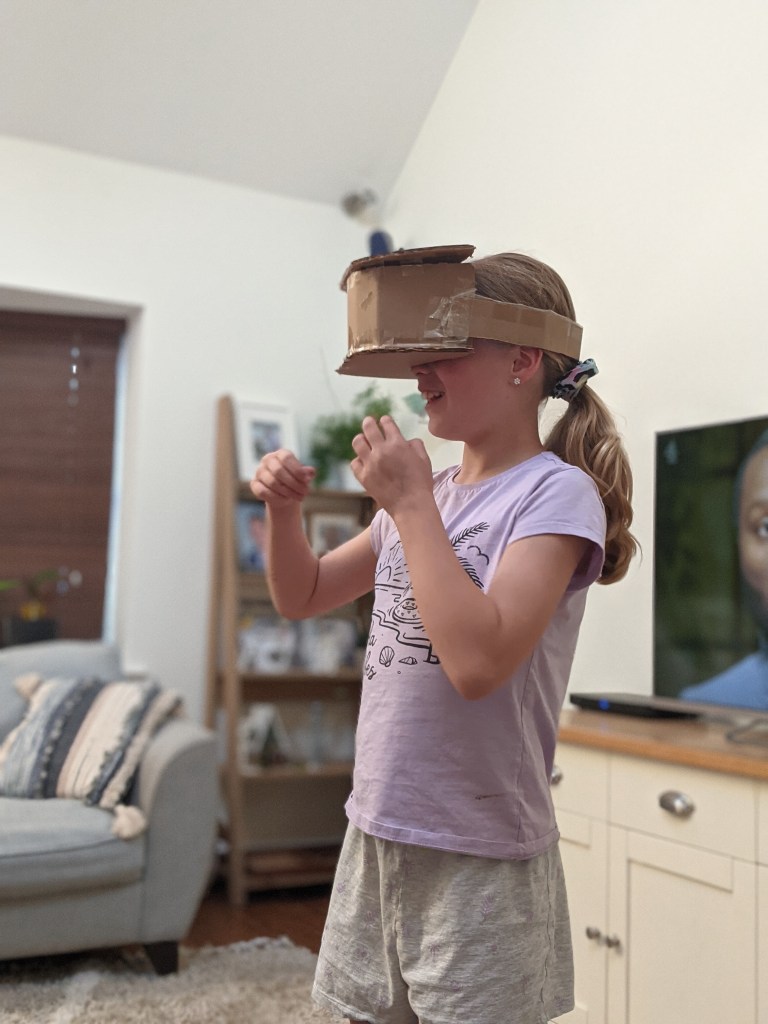
If no one will, then you have to
Here is my eldest daughter, aged 9, back in 2021, prototyping an Oculus Rift. She’s made it from card in her bedroom, it fits her head. Inside are a series of paper sketches of the “environment” she wants to explore. Shortly after this photo she iterates the design twice more, the first is to insert a long paper strip which moves as she turns her head to simulate VR, the second sees a mobile phone mounted inside. When she joins her local secondary school, her first project in D&T will be to practice wood joints with offcuts of pine. And apparently everyone thinks this is fine. I do not…
The aim… prove it can be done
The biggest issue D&T has is that it can’t be everything to everyone. Is it about making, designing, learning about technology, or something else? Is it craft, engineering, art, making, design thinking, cooking, or DIY? In some schools it might be experienced through textiles or food, in others it might be called resistant materials or graphics. Whether schools want to call it Product Design, Design Engineering, or even Wood Tech, the current version of the subject is a amalgamation of lots of previously separate “material areas” into one incohesive learning journey. And like all iterations, the current subject is a tweaked repeat of its previous versions, which in the past have included craft, fix and repair, metal working and technical drawing.
“Let’s end the obsession with making.”
– Me, to everyone I have spoken to for the past 2 years
Creating a new vision for a foundational subject in UK education
The task was to create a new vision, or at the very least, prove it could be done. Throughout the work, it was amazing to watch it shift and morph, until the final version felt like an accurate reflection of the communities it would serve. The new subject, called Responsible Design and Innovation (RD&I), compiles everything that industry, employers and higher education want (as a top down approach), but shaped and structured by the teachers, school leaders and community experts who would have to deliver it (as a bottom up approach). It imposes the requirement for curriculum reform of the subject onto the UK government which if adopted, would take everything developed and push it into the public domain for consultation, and take it out of the hands of those who had taken it from concept to final draft.
Today, the work is a signal to the sector that change is possible, deliverable, and though potentially painful, necessary.
Key outcomes
1. A collective vision representing a significant number of major stakeholders.
2. A carefully sequenced learning journey that can meet the needs of UK schools
3. A blueprint for reform that has purpose, focus and epistemology
4. A user centred, systems thinking solution backed by research at every stage
5. A curriculum proposal that if delivered, would place the UK education system back at the top of the global education landscape for design education
Why RD&I?
Responsibility is the essential characteristic requirement we need from every single generation that will now follow in our footsteps into the world of work. Where we have failed to care for the environment, each other, or the finite resources we have, we must instil in our school education system the skills to enact change where we have failed. Responsibility means making the right decision for:
Our planet – all of the inhabitants
Our society – ensuring accessibility, inclusion, equity for everyone
Design remains a foundational capability that all children should develop. Being able to design throughout your life is something everyone needs to be able to do, making a shared set of core design learning experiences the minimum our education system should provide.
Innovation is what drives the economy, and helps the UK to thrive through new sectors, jobs and the creation of wealth. The opportunity to learn how to solve problems and create new solutions in ways not thought of before, will not only lead to commercial opportunities, but help us solve the climate centred issues that are compounded by a lack of innovation.
The following links will take you to the key outcomes of the Future of Design Education campaign that I have been leading for the past 2 years:
Pearson – Future of Design Education – the landing page for the vision work.
Programme of study KS1-2 – a recreation of the DfE primary curriculum PoS
Programme of study KS3 – a recreation of the DfE 11-14 yrs curriculum PoS
GCSE Subject Content – a recreation of the DfE subject content for a new subject called Responsible Design and Innovation
A Level Subject Content – a recreation of the DfE subject content for a new subject called Responsible Design Engineering and Innovation
Some of the media reactions to this work
FE News
Design Week
The Standard
 Phil Holton